
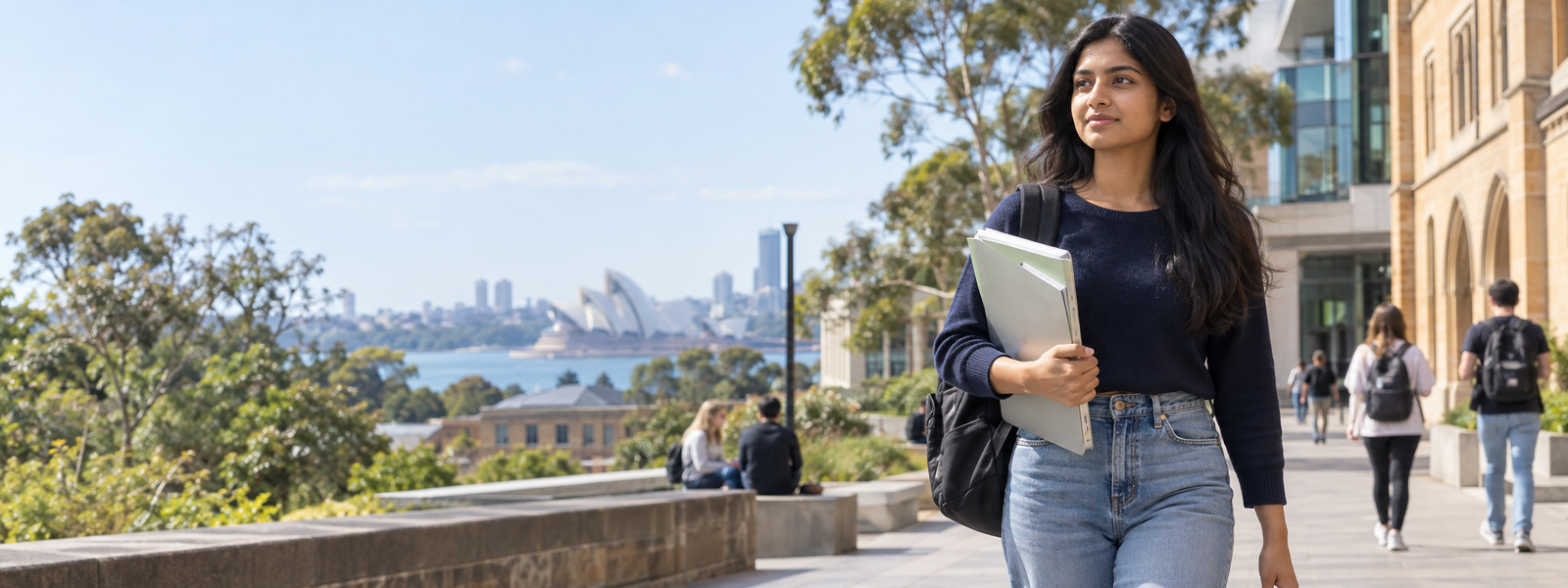
Australia Student Visa Rules 2026
Australia’s international student program has gone through its most significant reform period in over a decade. Changes introduced from 2024 onwards have reshaped the way students apply, the way applications are assessed, and the number of new students Australia accepts each year.
If you are an Indian student planning to study in Australia in 2026, understanding these updates before you apply is essential. Applying under outdated assumptions is one of the most common reasons for refusals.
This guide explains the key changes to the Australian Subclass 500 student visa in clear, practical terms.
What Has Changed for Australia Student Visas Since 2024?
The following major changes have come into effect:
- The Genuine Temporary Entrant (GTE) requirement was replaced by the Genuine Student (GS) requirement
- Financial proof requirements were updated with significantly higher minimum living cost amounts
- The Subclass 500 student visa application fee was substantially increased in 2024
- A national planning level was introduced, placing a cap on the number of new international student places
- Ministerial Direction 115 established new priority processing orders for student visa applications
- Restrictions were introduced on switching from a visitor visa to a student visa from within Australia
- Changes were made to the Subclass 485 (Post-Study Work) visa rules
Each of these changes affects how Indian students should approach their application.
The Genuine Student (GS) Requirement
What Replaced the Genuine Temporary Entrant (GTE)?
The Genuine Temporary Entrant (GTE) requirement was a long-standing assessment that required applicants to demonstrate they genuinely intended to stay in Australia temporarily for study and then return home.
In 2024, the Australian Government replaced the GTE with the Genuine Student (GS) requirement. The GS requirement applies to the Subclass 500 student visa and is assessed by Department of Home Affairs officers as part of the application.
How Is the GS Assessment Conducted?
Under the GS framework, a visa officer assesses whether the primary purpose of your visa application is genuinely to study in Australia.
The assessment considers:
- Your personal circumstances in your home country (India), including family ties, employment, and financial situation
- Your immigration history and compliance with previous visa conditions
- The potential migration incentive: whether your circumstances suggest an intent to remain in Australia beyond your visa period
- The value of the course to your career and educational goals
- Whether the course choice is consistent with your academic background
The GS assessment is broader and more holistic than the previous GTE requirement. A strong, specific study plan that clearly explains your reasons for choosing Australia, your chosen institution, and your intended career pathway is now more critical than ever.
Official guidance on the GS requirement is available at the Department of Home Affairs student visa page.
Financial Proof Requirements for the Subclass 500 Visa
Financial proof is one of the most scrutinized parts of the student visa application. The Australian Government updated financial requirements as part of the 2024 reforms.
What You Need to Show
You must demonstrate that you have enough funds to cover:
- Course fees for your first 12 months of study (as stated in your Confirmation of Enrolment)
- Living costs for yourself for 12 months
- Living costs for any accompanying partner or dependants
- School costs for any school-age children accompanying you
- Return airfare to India
Current Living Cost Benchmarks
The Department of Home Affairs updates its required living cost amounts annually. Based on recent updates, the minimum living cost requirement for the main applicant has been significantly higher than the figures applied before 2024.
Verify the exact current figure for living costs on the DHA financial evidence page before applying. Using an outdated figure is a common cause of application problems.
Accepted Forms of Financial Evidence
Acceptable evidence of financial capacity includes:
- Bank statements showing consistent funds over 3 to 6 months
- A letter from a bank confirming a term deposit or fixed deposit
- Evidence of a scholarship or sponsorship covering fees and living costs
- A letter from your employer (if you or a parent is the financial sponsor) with supporting salary slips and bank statements
- An education loan sanction letter from a recognized Indian bank
As with all financial documentation for Australian visas, funds that appear as large, recent deposits (without explanation) are treated with scrutiny. Funds should reflect a consistent financial position, not last-minute transfers.
Australia Student Visa Application Fee 2026
The student visa application fee (Subclass 500) was significantly increased in 2024. This was part of a broader Australian government policy to reduce net migration and generate additional revenue from the visa system.
The fee was raised from AUD 710 to approximately AUD 1,600 for the main applicant.
Additional charges apply for each accompanying family member (partner, dependants) who is added to the same application.
Verify the exact current application fee on the DHA visa pricing page before submitting, as visa fees are subject to further revision. Visa application fees are non-refundable in most cases.
The National Planning Level: Australia's International Student Cap
One of the most significant structural changes to Australia’s international education system is the introduction of a national planning level for new international student places.
What Is the National Planning Level?
The national planning level is a government-set limit on the number of new international student visa grants (first-entry applications) per calendar year. Under this framework:
- The federal government sets an overall annual cap for new international students
- Individual universities and education providers are allocated a share of this cap
- Providers cannot enroll international students above their allocated limit
This change was enabled by new legislative powers under Australia’s international education framework. It marks a fundamental shift from Australia’s previous unlimited approach to international student growth.
What This Means for Indian Applicants
A university’s allocation being full can affect when you receive a Confirmation of Enrolment (CoE), which is required before you can submit a student visa application. If you are targeting a particular intake, apply early and confirm your institution’s current enrollment capacity.
Ministerial Direction 115: Priority Processing
The Department of Home Affairs manages offshore student visa processing through ministerial priority directions. Rather than a simple first-come, first-served queue, processing speed is largely tied to provider capacity and risk profiles:
- High Priority: Applications for institutions that are well below their allocated student thresholds and demonstrate high compliance benchmarks.
- Standard / Lower Priority: Applications linked to institutions nearing or exceeding their capacity limits, or providers facing heightened integrity scrutiny.
For current processing time estimates, monitor the DHA processing times tool, and check with your chosen provider regarding their intake status.
Subclass 485 Post-Study Work Visa: Key Changes
The Subclass 485 (Temporary Graduate) visa allows international graduates to stay and work in Australia after completing their studies. Changes introduced in 2024 have affected both eligibility and duration.
Key changes to be aware of:
- Stream alignment with skills shortages: The Australian Government has increasingly linked Subclass 485 eligibility and duration to Australia’s skills shortage needs. Graduates in priority occupations may be eligible for extended post-study work rights.
- Regional study extensions: Students who studied at a regional campus or regional institution may qualify for additional post-study work time under the Regional stream.
- Course eligibility tightening: Not all courses at all institutions qualify for Subclass 485. The course must meet minimum duration requirements (at least 2 years of study in Australia).
- English proficiency: A minimum English language test result is required to apply for the Subclass 485.
Official guidance on Subclass 485 eligibility and streams is available at the DHA Subclass 485 page.
Can You Switch from a Visitor Visa to a Student Visa Inside Australia?
No. Effective 1 July 2024, the Australian Government officially banned onshore applications for Subclass 500 student visas from holders of certain temporary visas, including Visitor visas (Subclass 600, 601, 651) and Temporary Graduate visas (Subclass 485).
If you enter Australia on a tourist or visitor visa, you cannot lodge an onshore student visa application. You must depart Australia and apply from offshore (e.g., from India). Offshore applicants are not eligible for a bridging visa to remain in Australia while their application is processed.
Common Reasons for Student Visa Refusal in 2026
Understanding refusal reasons helps you avoid them.
The most common reasons for Subclass 500 student visa refusals include:
- Failing the Genuine Student assessment: The visa officer is not satisfied that your primary purpose is to study in Australia
- Insufficient or inconsistent financial evidence: Funds that do not meet the required minimums, or bank statements showing recent large deposits without explanation
- Weak or generic study plan: A study plan that does not clearly connect your academic background, the course, and your career goals
- Poor immigration history: Previous visa refusals, overstays, or non-compliance with earlier visa conditions
- Choosing a provider under scrutiny: Some registered providers have reduced credibility with the DHA; always verify your institution’s standing
- Incomplete documentation: Missing the CoE, incorrect English test results, or documents not meeting DHA format requirements
Document Checklist: Subclass 500 Student Visa 2026
Use this checklist before submitting your application:
Mandatory Documents:
- Valid passport (at least 6 months beyond intended study period)
- Confirmation of Enrolment (CoE) from a registered Australian education provider
- Genuine Student assessment evidence (study plan, career explanation)
- Proof of financial capacity (bank statements, scholarship letters, loan documents)
- English language test results (IELTS, PTE, TOEFL as required by your institution)
- Overseas Student Health Cover (OSHC) for the full duration of your course
- Biometrics (if required; collected at a VAC center in India)
Supporting Documents (Strengthen Your Application):
- Academic transcripts and certificates for all previous education
- Employment records (if applying as a working professional)
- Evidence of ties to India (property documents, family, employment letters)
- Previous travel history (UK, USA, Schengen visa copies if applicable)
- Scholarship or sponsorship letters if applicable
Frequently Asked Questions
What is the financial requirement for an Australia student visa in 2026?
You must demonstrate funds to cover your first-year course tuition, 12 months of living costs for yourself and any accompanying family members, school costs for dependent children, and return airfare to India. The minimum living cost benchmark for the main applicant was significantly increased in 2024. The exact current figure is updated annually by the Department of Home Affairs. Verify the current required amount on the DHA financial evidence page before you apply. Financial proof should reflect consistent funds over 3 to 6 months, not recent large deposits.
What replaced the old Genuine Temporary Entrant (GTE) requirement?
The Genuine Temporary Entrant (GTE) requirement was replaced by the Genuine Student (GS) requirement, which came into effect in 2024. The GS assessment is more comprehensive. It considers your personal circumstances in India, your potential migration incentive, your immigration history, the value of the chosen course to your career, and the credibility of your study plan. A specific, well-written study plan that clearly connects your background, your course choice, and your career goals is the most important document for the GS assessment.
Has the Australia student visa application fee changed in 2026?
Yes. The Subclass 500 student visa fee was significantly increased in 2024 from AUD 710 to approximately AUD 1,600 for the main applicant. Additional charges apply for accompanying family members. Visa application fees are non-refundable. Verify the current fee on the DHA visa pricing page before submitting, as fees are subject to revision.
Can I switch from a visitor visa to a student visa from within Australia in 2026?
No. Since 1 July 2024, visitor visa holders are legally barred from applying for a Subclass 500 student visa while inside Australia. You must return to your home country (or lodge from offshore) to apply for your student visa.
What is Australia's national planning level for new international student places in 2026?
Australia introduced a national planning level that sets an annual cap on the number of new international student visa grants. Under this framework, individual universities and education providers are given enrollment allocations. This means that a provider’s international student capacity can be limited regardless of your eligibility. The specific planning level figure for 2026 is set by the Australian Government and published through the Department of Education. Check the Australian Department of Education international student policy page for the current approved planning level before selecting your institution and intake.
Plan Your Australia Study Journey
Australia’s international student program has become more structured and selective. A thorough, well-prepared application gives you the strongest foundation for a successful outcome.
ACEA Global’s counselors can help you understand the latest requirements, shortlist CRICOS-registered institutions, prepare your study plan and financial documentation, and support your Subclass 500 application.
Contact ACEA Global for guidance on studying in Australia and explore available programs that match your academic goals.
Study Abroad
- Study in Australia
- Study in Canada
- Study in Denmark
- Study in Finland
- Study in France
- Study in Germany
- Study in Ireland
- Study in Latvia
- Study in Lithuania
- Study in Netherlands
- Study in Sweden
- Study in UK
English Coaching
- PTE
- ILETS