
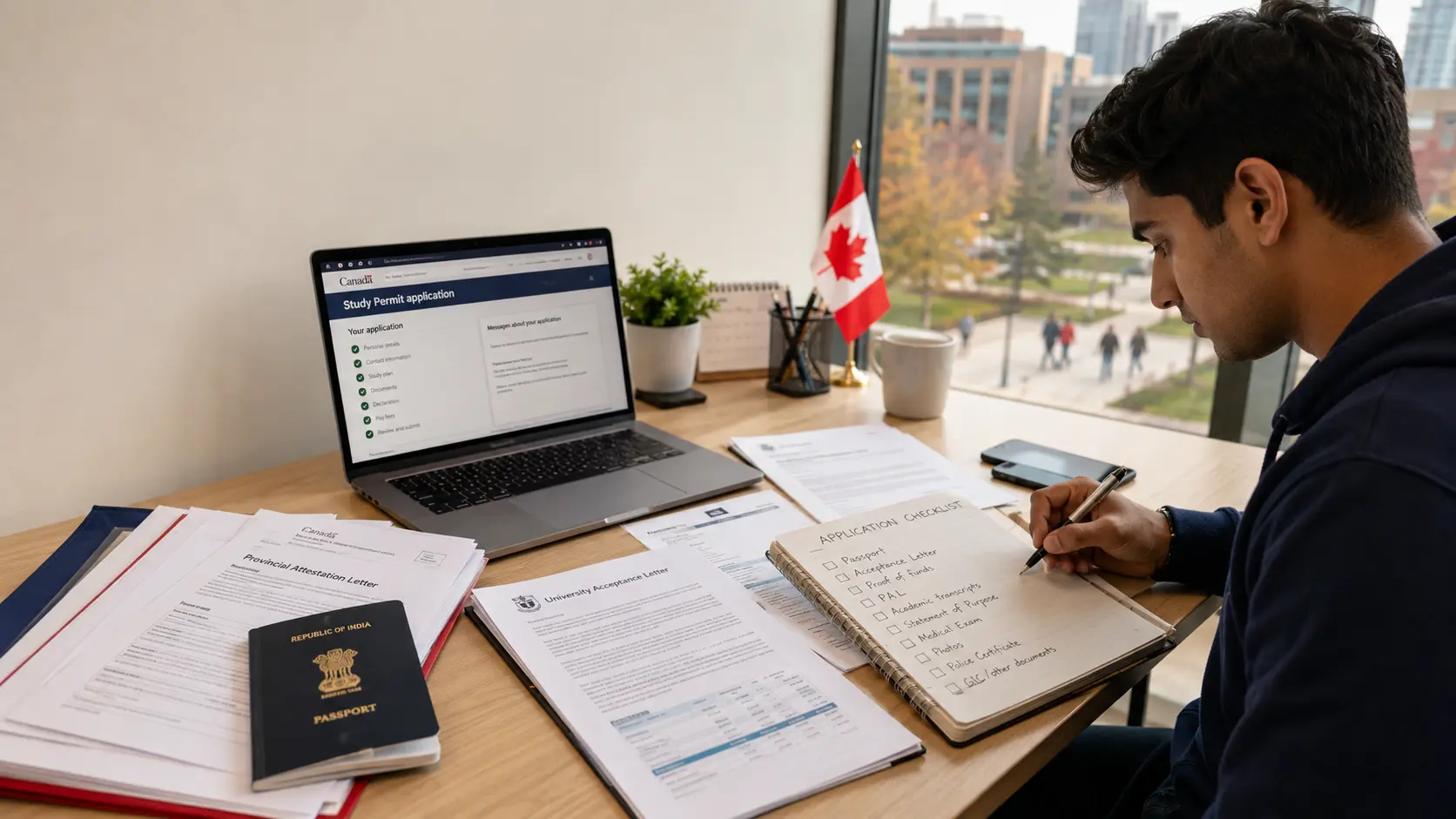
The Ultimate Checklist for Canadian Study Permit: 2026 New Rules Explained
Canada remains one of the most sought-after study destinations for Indian students. But the application process has changed significantly since 2023 and again through 2026.
New rules around financial proof, provincial attestation, study permit compliance, and the Genuine Student requirement have made the process more detailed than before. At the same time, the Student Direct Stream (SDS), which Indian students relied on for faster processing, no longer exists.
This guide gives you a complete, up-to-date checklist for the Canadian study permit in 2026, explains what changed, and tells you exactly what to prepare before you apply.
Important: Canadian immigration policy changes regularly, and IRCC has made several updates in 2026 alone. Always verify current requirements on the official Immigration, Refugees and Citizenship Canada (IRCC) website before submitting your application.
What Changed for Canada Study Permits: 2023 to 2026
Several significant changes have affected how Indian students apply for Canadian study permits:
- The Student Direct Stream (SDS) was permanently discontinued in November 2023. All applicants, including those from India, now apply through the standard stream only.
- A cap on international study permits was introduced in 2024, reducing the total number of permits issued annually. For 2026, IRCC’s national target is 408,000 study permits.
- A Provincial Attestation Letter (PAL) became mandatory for most undergraduate applicants.
- The Genuine Student (GS) requirement replaced the previous genuine temporary resident assessment, adding more scrutiny to applications.
- Proof of funds requirements were updated in 2024, significantly increasing the minimum amount needed for living expenses.
- Off-campus work hours for eligible students were permanently raised from 20 to 24 hours per week.
- Changes to the Post-Graduation Work Permit (PGWP) now tie eligibility to specific program types and in-demand occupations.
Understanding each of these changes is essential before you prepare your application.
Critical Update: The SDS Programme No Longer Exists
This is one of the most important updates for Indian students to know.
The Student Direct Stream (SDS) was a faster processing route previously available to students from India and several other countries. It offered expedited processing (as fast as 20 days) in exchange for meeting stricter upfront documentation requirements such as a completed GIC and an unconditional acceptance letter.
IRCC permanently cancelled SDS on November 8, 2023.
All applications, including those from India, now go through the standard study permit stream. There is no faster lane. Processing times under the standard stream are longer, and requirements differ from what SDS applicants previously submitted.
If you have read about SDS processes on older websites or study abroad forums, that information no longer applies. Check the IRCC study permit page for the current requirements.
What is a Provincial Attestation Letter (PAL)?
The Provincial Attestation Letter (PAL) is one of the newest requirements introduced as part of Canada’s international student cap.
Most undergraduate-level applicants need a PAL from the province or territory where their institution is located. The PAL confirms that your application falls within that province’s allocated study permit quota.
Who needs a PAL:
- Most students applying for college or undergraduate university programs
- Students at institutions in provinces that have implemented the PAL requirement
Who is generally exempt from the PAL:
- PhD students
- Master’s degree students (in many provinces)
- Elementary and secondary (K-12) school students
- Students applying to certain short-term programs
The PAL is typically issued by the institution or the provincial government once your acceptance is confirmed. Check with your specific institution about how and when the PAL is issued.
IRCC’s official guidance on PAL requirements is available at Canada.ca.
The Genuine Student Requirement
The Genuine Student (GS) requirement is IRCC’s current framework for assessing whether an applicant’s primary purpose is to study in Canada.
A visa officer will assess:
- Whether your chosen program aligns with your academic and professional background
- Whether your study plan is credible and well-reasoned
- Whether you have ties to India that suggest an intention to return after your studies
- Whether your financial profile is consistent with your stated plan
- Whether your institution is a credible Designated Learning Institution (DLI)
This assessment replaced the previous “genuine temporary resident” framing and applies to all applicants from November 2024 onwards.
A strong, specific Study Plan (sometimes called a Statement of Purpose) is now more important than ever. A generic or vague study plan is a leading cause of refusals under the GS assessment.
Canada Study Permit 2026: Complete Document Checklist
Mandatory Documents
The following documents are required for all standard study permit applications:
- Valid passport: Must be valid for at least 6 months beyond your intended period of study. Ensure all family members listed on the passport have their own pages.
- Acceptance letter from a Designated Learning Institution (DLI): The letter must be unconditional and clearly state the program name, start date, duration, and tuition amount. Verify your institution’s DLI status on the official IRCC DLI list.
- Provincial Attestation Letter (PAL): Required for most undergraduate programs. Obtained from your institution or provincial authority.
- Proof of financial support: Sufficient funds to cover tuition for the first year and living expenses for the first year (see the Proof of Funds section below).
- Study Plan / Letter of Explanation: A clear, specific document explaining why you chose this program, this institution, and this country, and how it connects to your career goals.
- Digital photographs: Meeting IRCC’s official photo specifications.
- Biometrics: Most Indian applicants will need to provide fingerprints and a photograph at a biometric collection service point. Biometrics collected previously may still be valid for 10 years.
Supporting Documents (Strengthen Your Application)
These documents are not always mandatory but significantly strengthen your file:
- Academic transcripts and certificates: For all previous education (grade 10, 12, bachelor’s, or master’s as applicable).
- Language test results: IELTS, PTE, TOEFL, or equivalent as required by your institution.
- Financial documents: Bank statements for 3 to 6 months, Fixed Deposit receipts, loan sanction letters (if using an education loan).
- Scholarship or sponsorship letters: If applicable.
- Proof of ties to India: Employment records, property documents, family responsibilities, a post-study career plan.
- Previous travel history: Copies of any previously issued visas (UK, USA, Schengen) can support your credibility as a genuine temporary applicant.
- Relationship documents: If a dependent (spouse or child) is accompanying you.
Proof of Funds: How Much Do You Need?
GIC Amount and Living Expense Requirement 2026
IRCC has raised the proof-of-living-expenses requirement more than once since 2023.
Previously, a Guaranteed Investment Certificate (GIC) of CAD 10,000 was the standard for demonstrating living costs. Effective January 1, 2024, this was raised to reflect 75% of the Low-Income Cut-Off (LICO) for a single person, approximately CAD 20,635 per year at that time.
The figure has since risen again: as of 2026, applicants must generally demonstrate closer to CAD 22,895 in available funds for living expenses, on top of tuition and travel costs. This amount is tied to LICO and is updated periodically, so treat it as directional rather than final.
Always verify the exact current figure on the IRCC “Get your documents” page before applying, this number has moved twice in three years and is likely to move again.
Total funds you must demonstrate:
- First-year tuition (as stated in your acceptance letter)
- Living expenses for the first year (check current IRCC figure for 2026)
- Return transportation costs
How Can You Show Proof of Funds?
IRCC accepts the following as proof of financial support:
- A GIC from a participating Canadian financial institution
- Bank statements showing consistent, adequate funds
- Proof of a student loan or scholarship
- A letter of financial support from a parent or sponsor with supporting bank statements
- An education loan approval letter from a recognized Indian bank
If you are using a GIC, it must be purchased from an IRCC-approved Canadian bank. The GIC is partially released upon arrival in Canada and the remainder over the course of your first year. A GIC does not cover tuition. Tuition must be shown as a separate available amount.
How to Apply: Step-by-Step Process
Step 1: Receive an unconditional offer letter from a DLI.
Step 2: Confirm whether your institution has issued or will issue a Provincial Attestation Letter (PAL).
Step 3: Create an IRCC online account at Canada.ca.
Step 4: Complete the study permit application form (IMM 1294) and upload all required documents.
Step 5: Pay the application fee (CAD 150 as of current IRCC guidelines; confirm the current fee on the IRCC website).
Step 6: Submit biometrics if required at an authorized collection point.
Step 7: Wait for IRCC processing. Standard processing times vary. Check current processing times on the IRCC processing times tracker.
Step 8: If approved, receive your Port of Entry (POE) letter and study permit. If additional documents are requested (procedural fairness letter), respond promptly and completely.
Language Requirements
IRCC itself does not prescribe a specific English language test for study permit applications. Language requirements are set by the institution you are applying to.
Most Canadian institutions accept:
- IELTS Academic: Typically 6.0 to 7.0 (varies by program)
- PTE Academic: Typically 55 to 70 (varies by program)
- TOEFL iBT: Typically 80 to 100 (varies by program)
- Duolingo English Test: Accepted by select institutions
Check your specific institution’s language requirements before booking your test. Submit your test results as part of your application to demonstrate academic readiness.
Work Rights While Studying in Canada
International students in Canada can work off-campus during their studies. The current limit is up to 24 hours per week during academic sessions, a permanent increase from the earlier 20-hour cap, in place since late 2024 and continuing through 2026. Full-time work is permitted during scheduled academic breaks (summer, winter).
On-campus work does not require a separate work permit and is not subject to the 24-hour limit.
Practical Notes for 2026:
- The hour limit is cumulative across all employers — you can’t work 15 hours at one job and 15 at another.
- As of April 1, 2026, IRCC eliminated the separate co-op work permit requirement for programs with a mandatory work placement; students can now complete an eligible co-op or internship under their study permit alone, provided it doesn’t exceed 50% of total program length.
- If your study permit document still references “20 hours per week,” the 24-hour limit still applies as long as you meet all eligibility conditions — the permit wording hasn’t caught up everywhere.
Confirm the current rule on the IRCC “working off campus” page before relying on any figure, as this has changed more than once in recent years.
Post-Graduation Work Permit (PGWP): A Quick Overview
The Post-Graduation Work Permit (PGWP) allows graduates to work in Canada after completing an eligible full-time program at a DLI.
Key points:
- Duration: Typically equal to the length of your study program, up to a maximum of 3 years.
- Eligibility change: Graduates of college programs (outside of Quebec) must now be in a field related to occupations on Canada’s skills shortages list to qualify for a PGWP. University degree graduates are generally still eligible without this restriction, but conditions vary.
- One-time permit: A PGWP can only be issued once per person.
- Application timing: You must apply for the PGWP within 180 days of receiving written confirmation of completing your program.
- 2026 update: IRCC revised its PGWP guidance again in June 2026, including clarifications around non-credit programs of study. These changes have already contributed to real rejections for some graduates, so confirm your program’s PGWP eligibility before enrolling, not after.
PGWP rules have changed significantly in 2024 and may change further. Check the IRCC PGWP page before selecting your program, as PGWP eligibility now varies by program type.
Common Reasons for Study Permit Refusal
Understanding refusal reasons helps you avoid them.
The most common reasons for Canadian study permit refusals include:
- Insufficient funds: Bank statements that are inconsistent, show recent large deposits, or do not meet the updated LICO-based living expense requirement.
- Weak or generic Study Plan: A study plan that does not clearly explain why you chose this specific program, institution, and country.
- Failing the Genuine Student assessment: The officer is not satisfied that your primary purpose is to study temporarily in Canada.
- Weak ties to India: Insufficient evidence of family, employment, or other responsibilities that suggest you intend to return to India after your studies.
- Incomplete documentation: Missing the PAL, a disqualified DLI, or unsigned/expired documents.
- Mismatch between profile and chosen program: A course that does not logically connect to your educational or professional background, without adequate explanation.
Frequently Asked Questions
What are the new rules for Canada study permits in 2026?
The most significant changes affecting Indian students since 2023 include: the permanent cancellation of the Student Direct Stream (SDS) in November 2023; the Provincial/Territorial Attestation Letter (PAL/TAL) requirement, from which Master’s and PhD students at public institutions became exempt on January 1, 2026; a single PAL/TAL now covering joint programs across multiple institutions (since February 2026); the updated proof of living expenses requirement, now around CAD 22,895; the permanent rise in off-campus work hours from 20 to 24 per week; the Genuine Student (GS) requirement replacing the previous genuine temporary resident assessment; tighter compliance enforcement introduced in June 2026 around institution transfers and leaves from study; and ongoing changes to Post-Graduation Work Permit (PGWP) eligibility. Always verify current rules on the official IRCC website, as Canadian immigration policy has changed several times within 2026 alone.
How much GIC amount is needed for a Canada study permit?
As of the 2024 update, IRCC requires students to show proof of living expenses equal to 75% of the Low-Income Cut-Off (LICO) for a single person. Based on 2024 LICO figures, this is approximately CAD 20,635 per year. This started at approximately CAD 20,635 in 2024 and has since risen to roughly CAD 22,895. This amount is updated periodically, so check the current figure on the IRCC “Get your documents” page before applying. In addition to living expenses, you must also show proof of funds for your first-year tuition. A GIC from a participating Canadian bank is one accepted form of proof for living expenses, but it does not cover tuition.
What IT job opportunities are available in Latvia and Denmark?
No, IELTS is not specifically mandated by IRCC for a study permit application. The Student Direct Stream (SDS), which previously required IELTS 6.0 as a core requirement, was permanently cancelled in November 2023. Under the current standard stream, language proficiency requirements are set by your individual institution, not IRCC. Most Canadian institutions accept IELTS, PTE, TOEFL, or Duolingo, with specific score requirements varying by program. Check your institution’s admission requirements for the accepted tests and minimum scores.
Plan Your Canada Study Journey
The Canadian study permit process has more steps than before, but a well-prepared application built on complete and honest documentation gives you the strongest foundation.
ACEA Global’s counselors can guide you through every step: from shortlisting the right Designated Learning Institution to preparing your Study Plan, gathering your financial documents, and supporting your study permit application.
Contact ACEA Global for guidance on the Canada study permit process and explore international education options that suit your goals.
Study Abroad
- Study in Australia
- Study in Canada
- Study in Denmark
- Study in Finland
- Study in France
- Study in Germany
- Study in Ireland
- Study in Latvia
- Study in Lithuania
- Study in Netherlands
- Study in Sweden
- Study in UK
English Coaching
- PTE
- ILETS